

iPhone Duo Specs, Price & Dimensions (Confirmed)
Apple's first foldable is called the iPhone Duo. Confirmed specs, the 254 g problem nobody is talking about, and what the real dimensions mean for whether any case will fit.
 Editorial
Confirmed
Apple announced its first foldable on 9 September 2026. It is called the iPhone Duo — not iPhone Fold, not iPhone Ultra. Pre-orders open 16 October, shipping 23 October. From US$1,999 (256GB) to US$3,199 (2TB).
Folded it measures 117.8 × 84.1 × 11.3 mm and weighs 254 g. Those are the numbers that decide whether a case fits, and they are more interesting than the ones Apple put on stage.
Everyone is writing about the 5.2 mm. We design foldable cases, so we went looking at the other number.
By Priya Nair · FoldifyCase foldable case design team · 10 September 2026
The headline, and the number underneath it
Apple's line is that the iPhone Duo is the thinnest iPhone ever made — 5.2 mm. That is true, and it is a genuine engineering achievement. Unfolded, it is thinner than the iPhone Air.
It is also, closed, the thickest folding phone in its class.
| Closed thickness | |
|---|---|
| Galaxy Z Fold 8 Ultra | 8.9 mm |
| Galaxy Z Fold 8 | 9.7 mm |
| iPhone Duo | 11.3 mm |
A foldable spends most of its life closed, in a pocket. The number you actually live with is 11.3 mm — 2.4 mm more than the Z Fold 8 Ultra, which is a lot when you are talking about something you sit down with.
And here is the part that is our problem rather than Apple's: a case only ever adds to the closed number. A two-piece foldable case puts material on both outer faces. At a 1 mm wall per half — which is slim, not rugged — you are looking at roughly 13.3 mm in the pocket. Rugged designs will push past 15 mm.
Then there is the weight
254 g. That is the figure that made us sit up.
| Device | Weight | vs iPhone Duo |
|---|---|---|
| Galaxy Z Fold 8 | 201 g | −53 g |
| Galaxy Z Fold 8 Ultra | 215 g | −39 g |
| iPhone Duo | 254 g | — |
Titanium is strong, but it is not light. Grade 5 titanium in both the frame and the hinge is what gives the Duo its rigidity — and 53 g more than the Z Fold 8.
Add a case and you are carrying something close to 300 g. That is a real consideration, and it shapes what we would build: on this device, every gram of case has to justify itself. Chunky rugged designs that work fine on a 200 g phone become genuinely unpleasant here.
The full confirmed spec sheet

| Folded | 117.8 × 84.1 × 11.3 mm |
| Unfolded | 117.8 × 164.6 × 5.2 mm |
| Weight | 254 g |
| Inner display | 7.6in LTPO Super Retina XDR OLED, 1878 × 2670, 120Hz, 3000 nits peak, Nano Texture finish |
| Cover display | 5.4in, 1398 × 2034, 460 ppi, Ceramic Shield 2 |
| Build | Grade 5 titanium frame and hinge, Ceramic Shield 2 front, Ceramic Shield back |
| Water/dust | IP68 — dust tight, immersible to 6 m for 30 min |
| Chipset | Apple A20 Pro (2 nm), 12GB RAM, iOS 27. Vapour-chamber cooling, dual-battery architecture |
| Rear cameras | 48MP Fusion Main f/1.6 with sensor-shift OIS + 48MP Fusion Ultra Wide f/2.2. No dedicated telephoto lens — the 2× is a crop from the main sensor |
| Front cameras | Under-display camera on the inner panel — no cutout, 12MP Center Stage on the cover |
| Biometrics | Touch ID in the side button |
| Charging | Wired PD3.2, 50% in 20 min · 25W MagSafe / Qi2, 50% in 30 min |
| SIM | eSIM only — no tray |
| Stylus | Supported |
| Colours | Night Sky, Star White |
| Price | From US$1,999 (256GB) to US$3,199 (2TB) · about €2,300 |
The spec nobody is leading with, and probably should be
IP68. Dust tight.
Every Samsung book-style foldable to date, including the Z Fold 8 Ultra, is rated IP48. The 4 means it resists solid objects larger than 1 mm — it does not keep out fine dust. The iPhone Duo is rated IP68: fully dust tight, and immersible to 6 metres.
If you have followed foldables for any length of time, you will know why this matters. Dust in the hinge has been the defining failure mode of the category. Grit works its way into the mechanism, then into the fold of the inner panel, and the damage is expensive and usually terminal. Samsung has been chipping away at it for years and has not closed the gap.
Apple appears to have closed it on the first try. If that rating holds up in real-world use — and we will be watching teardowns closely — it is the most significant thing about this device, and it barely got a mention on stage.
It also changes what a case is for. On a Samsung foldable, part of the case's job is keeping grit out of the hinge zone. On a genuinely dust-tight device, that pressure comes off, and the case can concentrate on what it is actually good at: drop energy, corner protection, and grip on a heavy object.
The other thing Samsung gave up and Apple did not
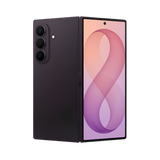
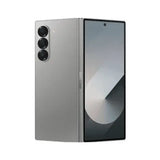
Look closely at the inner display above. There is no punch-hole, no notch, nothing. The selfie camera sits under the panel.
Samsung shipped under-display cameras on the Z Fold 3 through 6, then removed the feature on the Z Fold 7 and has not brought it back. Apple has arrived with one working on its first attempt. It is a lower-specification camera than the 12MP Center Stage unit on the cover display — Apple lists f/1.8 and 1080p video — so you will want the outer camera when the shot matters. But the uninterrupted inner panel is real, and it is the detail that gives the device away in photographs.
It is also, incidentally, how you can spot imagery made before the launch. Every pre-announcement render we have seen drew a punch-hole in the corner of the inner screen. If a listing is using one of those pictures, it was made by someone who had not seen the phone.
What Apple left out
Two absences worth naming at US$1,999.
No dedicated telephoto lens. Two 48MP cameras — a Fusion Main and a Fusion Ultra Wide. Apple markets an "optical-quality 2× Telephoto", but that is a crop from the main sensor rather than a third lens. The Galaxy Z Fold 8 Ultra has a 200MP main, a 50MP ultrawide and a genuine 10MP 3× telephoto for US$2,099. If you photograph anything at distance, that is a real gap.
No Face ID. Touch ID lives in the side button instead. We wrote about why that rules out an entire category of case design before the announcement, and the confirmation makes it concrete: any case that covers the power button will break the unlock. Capacitive sensors need bare skin. If you are shopping rugged, check for an open, chamfered cutout at that button before anything else.
Will any existing case fit? No — and here is exactly why
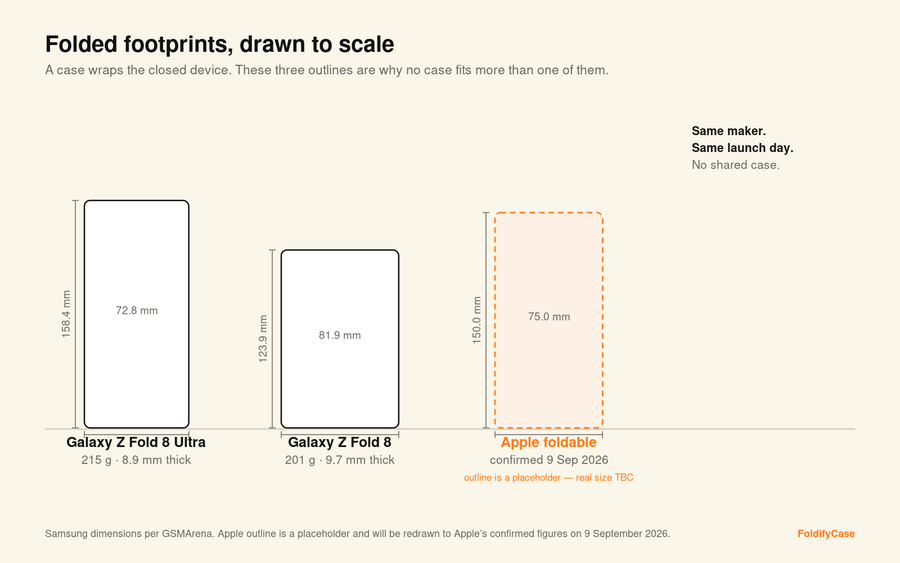
The iPhone Duo's folded footprint is, interestingly, closest to Samsung's wide Galaxy Z Fold 8 rather than the tall Ultra.
| Folded | Height | Width | Thickness |
|---|---|---|---|
| iPhone Duo | 117.8 mm | 84.1 mm | 11.3 mm |
| Galaxy Z Fold 8 | 123.9 mm | 81.9 mm | 9.7 mm |
| Galaxy Z Fold 8 Ultra | 158.4 mm | 72.8 mm | 8.9 mm |
Against the Z Fold 8 it is 6.1 mm shorter, 2.2 mm wider and 1.6 mm thicker. In a photograph those two devices look like siblings. In a case mould they are unrelated.
To put that in perspective: a camera cutout machined 0.3 mm off centre will vignette an ultrawide shot. We are talking about differences five to twenty times that size, in all three axes at once. There is no adaptation, no stretch, no "close enough". The Duo needs tooling cut for the Duo.
Apple is selling its own cases from day one

Apple announced its own iPhone Duo Case and a Folio alongside the phone, in four colours. That is worth knowing for two reasons.
The first is practical: on day one, Apple's is the only case guaranteed to have been designed against the real hardware. If you want protection on 23 October and nothing else, that is the honest answer, and we would rather tell you that than sell you something we have not measured.
The second is what it tells you about the device. Apple building a two-piece case for a foldable at all is a signal about how much the closed thickness and the coated inner panel constrain the design — the same constraints we set out below, arrived at independently.
What we would design for this device
Reading the spec sheet as a brief, four things stand out.
- Thin walls, aggressive corners. At 11.3 mm and 254 g, bulk is the enemy. Put the material where drops actually land — corners and the hinge edge — and take it off everywhere else.
- An open, chamfered power-button cutout. Non-negotiable with side-button Touch ID.
- Nothing touching the inner panel. The Nano Texture finish is a coated surface, and coated surfaces mark. Raised bezels, zero contact when closed.
- Magnet transparency, not magnet addition. The Duo has 25W MagSafe built in. Unlike our Samsung cases, which add a magnet array, a Duo case has to get out of the way of one and keep it aligned.
One bonus: eSIM only means no SIM tray, which is one less cutout to get wrong and slightly more structural continuity along the bottom rail. Small mercy, genuinely useful.
When you can actually buy a third-party case
Pre-orders for the phone open 16 October and it ships 23 October. Third-party cases that genuinely fit come after that, not before — because tooling requires a retail unit on a bench with calipers on it.
You will see iPhone Duo cases listed within days. They will be moulded from the same leaked CAD that had this device down as the "iPhone Fold" with different dimensions entirely — and, as above, illustrated with renders that drew a camera hole in a screen that does not have one. We set out the full reasoning in why you will wait weeks for a case that actually fits, and nothing about the announcement changes it.
Pre-order · dispatched after we measure
That includes ours, so here is where we stand
We have two cases tooled for the iPhone Duo. Having just spent an article telling you to distrust anything cut before launch, we are not going to pretend ours are an exception: these moulds were cut from pre-release dimensions, like everyone else's. Nobody has measured a retail unit, because nobody has one until 23 October.
The difference is what happens on that date. We are buying a Duo and putting calipers on it, and pre-orders are not dispatched until the fit is confirmed against that unit. If the tooling is out, we recut it rather than ship you a case that does not fit. That is the whole reason to reserve with us instead of buying the first listing you find.

Kinetic P1
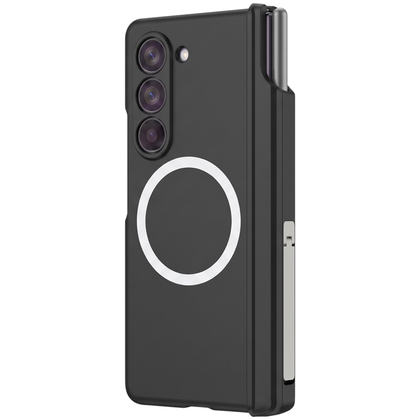
Full hinge cover with a stylus slot on the spine — the Duo supports a stylus. Three colours.
A$129.00
Reserve the Kinetic P1
Axon M1
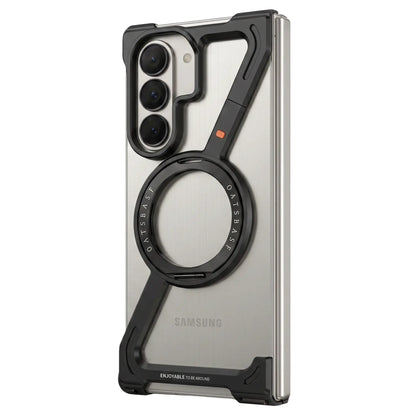
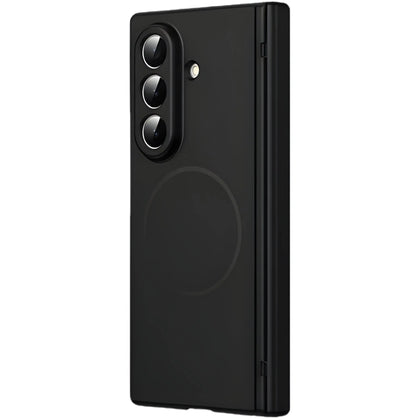
Clear shell with a rotating ring grip and kickstand — useful on a 254 g phone. Six accent colours.
A$129.00
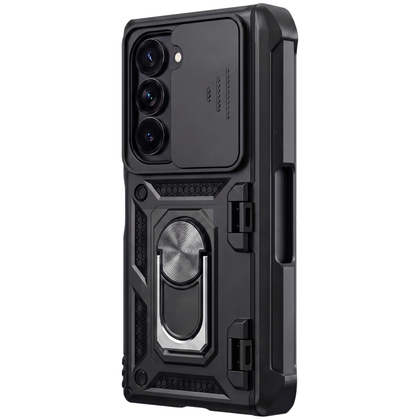
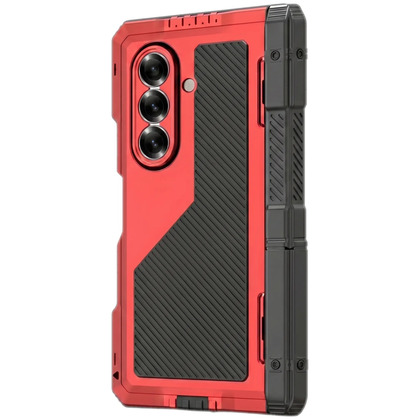
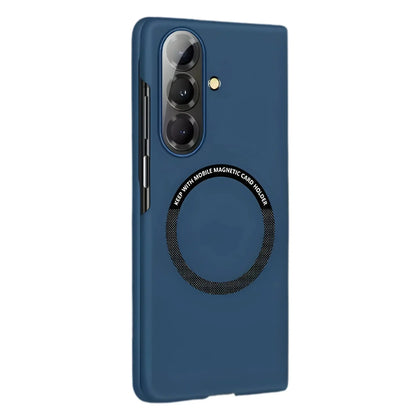
Reserve the Axon M1Product photography shows the Galaxy Z Fold versions. The iPhone Duo version of each case is a separate mould. Dispatch expected from late October once fit is verified against a retail unit; 30-day returns apply.
Measured, not guessed
Not ready to commit? Get the measurements first
We are buying a Duo on 23 October. Calipers, teardown photos, and an honest answer on what fits — published the week we get it. One email, no spam, no renders.
So — is it any good?
We design cases, not phone reviews, so take this as a structural read rather than a verdict.
Apple has done the hard part properly. IP68 on a book-style foldable is a first, and it addresses the failure mode that has quietly killed more foldables than drops ever have. The titanium hinge, the Ceramic Shield 2 cover glass and the claimed small crease all point the same way: this is built to survive being a foldable, which is not something we could say about the first generation from anyone else.
What Apple traded for it is weight and closed thickness. 254 g and 11.3 mm is the cost of that titanium and that ingress sealing. Whether that trade is right for you depends entirely on whether you have ever had grit in a hinge.
And at US$1,999 with no dedicated telephoto, the camera system is the weakest part of the sheet. The Z Fold 8 Ultra costs US$100 more and gives you a 200MP main and a true 3× telephoto.
Frequently asked questions
What is the iPhone Duo called and when does it launch?
Apple's first foldable is the iPhone Duo, announced 9 September 2026. Pre-orders open 16 October 2026 and it ships 23 October 2026.
How much does the iPhone Duo cost?
From US$1,999 for 256GB, rising to US$3,199 for 2TB. European pricing is around €2,300. Check Apple's regional store pages for local pricing.
What are the iPhone Duo's dimensions?
Folded it is 117.8 × 84.1 × 11.3 mm. Unfolded it is 117.8 × 164.6 × 5.2 mm. It weighs 254 g. At 5.2 mm unfolded it is Apple's thinnest iPhone; at 11.3 mm folded it is thicker than any current Samsung book-style foldable.
Is the iPhone Duo waterproof?
It carries an IP68 rating — fully dust tight and immersible to 6 metres for 30 minutes. That is notably better than the IP48 rating on Samsung's Galaxy Z Fold 8 and Z Fold 8 Ultra, which resist objects larger than 1 mm but are not dust tight.
Does the iPhone Duo have Face ID?
No. It uses Touch ID built into the side button. This means a case must leave that button open — a covered power button will prevent the fingerprint sensor from reading.
Does the iPhone Duo have a telephoto camera?
Not a dedicated one. It has a 48MP Fusion Main and a 48MP Fusion Ultra Wide. Apple's "2× Telephoto" is an optical-quality crop from the main sensor rather than a third lens. The Galaxy Z Fold 8 Ultra does have a separate 3× telephoto.
Does the iPhone Duo have a camera hole in the inner screen?
No. The inner 7.6in display uses an under-display camera, so there is no punch-hole or notch. The 5.4in cover display has a conventional 12MP Center Stage camera. Any image showing a cutout in the inner panel was made before the announcement.
Does Apple make its own iPhone Duo case?
Yes. Apple announced an iPhone Duo Case and an iPhone Duo Folio alongside the device, available in four colours. On launch day these are the only cases designed against the real hardware rather than pre-release estimates.
Can I pre-order a FoldifyCase iPhone Duo case?
Yes. The Kinetic P1 and Axon M1 are tooled for the iPhone Duo at A$129.00 each. Those moulds were cut from pre-release dimensions, so pre-orders are not dispatched until we have measured a retail iPhone Duo and confirmed the fit. Dispatch is expected from late October.
Will a Galaxy Z Fold case fit the iPhone Duo?
No. The Duo folds to 117.8 × 84.1 × 11.3 mm, the Galaxy Z Fold 8 to 123.9 × 81.9 × 9.7 mm and the Z Fold 8 Ultra to 158.4 × 72.8 × 8.9 mm. All three differ in every axis, and camera and button positions differ too. Each needs its own tooling.
Does the iPhone Duo support a stylus?
Yes, stylus support is listed in the specifications. Apple has not detailed which stylus or whether one is included.
When will third-party iPhone Duo cases be available?
Cases that genuinely fit require measurements taken from a shipping device, so expect them after the 23 October release rather than before. Cases listed before then are moulded from pre-release estimates.
Related guides
- Touch ID and what it rules out for case design
- Why you will wait weeks for a case that actually fits
- iPhone foldable cases: what to look for
- What to budget for a foldable iPhone
- Galaxy Z Fold 8 and Z Fold 8 Ultra: confirmed specs
Sources
- Apple Newsroom — Apple unveils iPhone Duo (product images used above)
- GSMArena — Apple iPhone Duo full specifications
- Engadget — Apple announces the iPhone Duo
- TechCrunch — Apple unveils its first foldable, the iPhone Duo
- MacRumors — iPhone Duo beats iPhone Air as Apple's thinnest iPhone, but only when open
- GSMArena — Galaxy Z Fold8 Ultra specifications
- GSMArena — Galaxy Z Fold8 specifications
Product images of iPhone Duo courtesy of Apple, used unmodified for editorial purposes. Apple, iPhone and MagSafe are trademarks of Apple Inc. FoldifyCase is not affiliated with or endorsed by Apple Inc. or Samsung.
Cases engineered
for the fold.
14 foldable-specialist designs — magnetic, hinge-cover, slim & S-Pen — each moulded to your exact model, not adapted from a slab-phone case.
Shop all 14 cases